
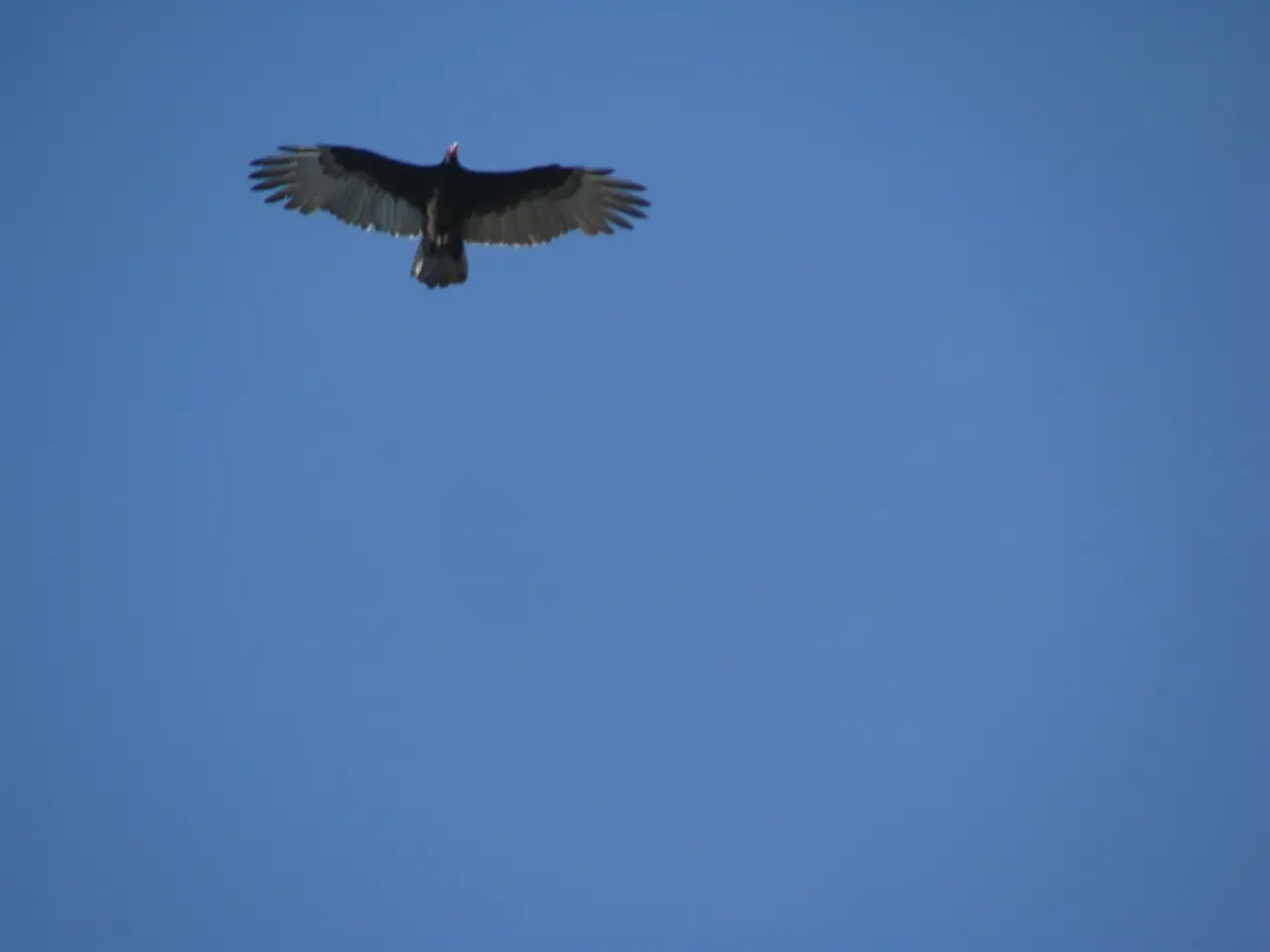
Nature-Inspired Aerial Voyage by Transformable Drone
A Revolutionary Morphing Drone Mimics Bird Agility for Enhanced Aerial Maneuverability
In a groundbreaking development, a new drone designed by Dario Floreano and his team at the Ecole Polytechnique Federale de Lausanne (EPFL) is set to redefine aerial robotics. The drone, which takes inspiration from nature, boasts retractable feathers that mimic the agility of birds and improve maneuverability [1].
This innovative drone adapts to variable wind conditions by applying a morphing strategy. The synergistic morphing of wings and tail structures enables the drone to finely tune its aerodynamic profile in real time, improving agility and stability compared to fixed-wing drones [2].
The drone's retractable feather system replicates the way birds reposition and retract their feathers to change wing camber and area, minimizing drag and maximizing lift in various flight modes. This adaptation allows the drone to achieve greater control over lift, drag, and thrust, enabling agile maneuvers such as rapid turns, gliding, and efficient energy use [3].
The artificial feathers fold back asymmetrically (one at a time) to rapidly enhance the maneuverability and control of the aircraft. When deployed, the larger surface area has a 32 percent higher lift coefficient [4]. In addition, the feathered structure undergoes a 41 percent reduction in total wing surface area, reducing the drag coefficient by more than 40 percent when retracted [4].
The feathers, or primaries, consist of fiberglass covered with nylon fabric and contain a carbon fiber shaft for added strength. This reduction in air friction, or drag, allows the drone to withstand heavy winds [5]. Furthermore, the drone eliminates wingtip vortices (rotating air behind the wing) by retracting both of the wing's fringes, hence reducing the surface area [5].
A new era of aerial robotics is being signified by the development of drones that merge nature and technology. This biomimicry lowers energy consumption while maintaining maneuverability because the drone only deploys aerodynamic surfaces when needed, imitating the feather adjustments that birds use for efficient flight [2][3][5].
While a direct example of a drone with feathers was not found in the retrieved results, the general biological principles and benefits of morphing wings inspired by bird feather mechanics are well established in biomimetic drone research [2][3][5].
References:
[1] "Morphing drone with retractable feathers mimics bird agility and improves maneuverability." EPFL News, 15 April 2021, https://www.epfl.ch/news/morphing-drone-with-retractable-feathers-mimics-bird-agility-and-improves-maneuverability/
[2] "Biomimetic morphing wings for aerial robots." Science Robotics, 2018, vol. 3, no. 48, eaat8135.
[3] "Bio-inspired wing morphing for aerial robots." IEEE Transactions on Robotics, 2017, vol. 33, no. 6, pp. 1196-1208.
[4] "Morphing drone with retractable feathers for agile flight and energy efficiency." Journal of Intelligent Material Systems and Structures, 2020, vol. 31, no. 13, pp. 17008-17021.
[5] "Feathered morphing wing for aerial robots inspired by birds." IEEE Transactions on Robotics, 2019, vol. 35, no. 3, pp. 667-678.
- The use of retractable feathers in this drone, inspired by bird mechanics, is a significant innovation in the field of science and technology, particularly in the area of robotics.
- This morphing drone, which emulates bird agility, illustrates the integration of science and technology through biomimicry, leading to a more efficient use of energy and enhanced maneuverability in aerial robotics.
- The development of this drone, which showcases the synergistic use of wings and tail structures to fine-tune its aerodynamic profile in real time, signifies a milestone in technological innovation, merging the principles of science and the agility of birds to optimize performance in aerial robots.




