
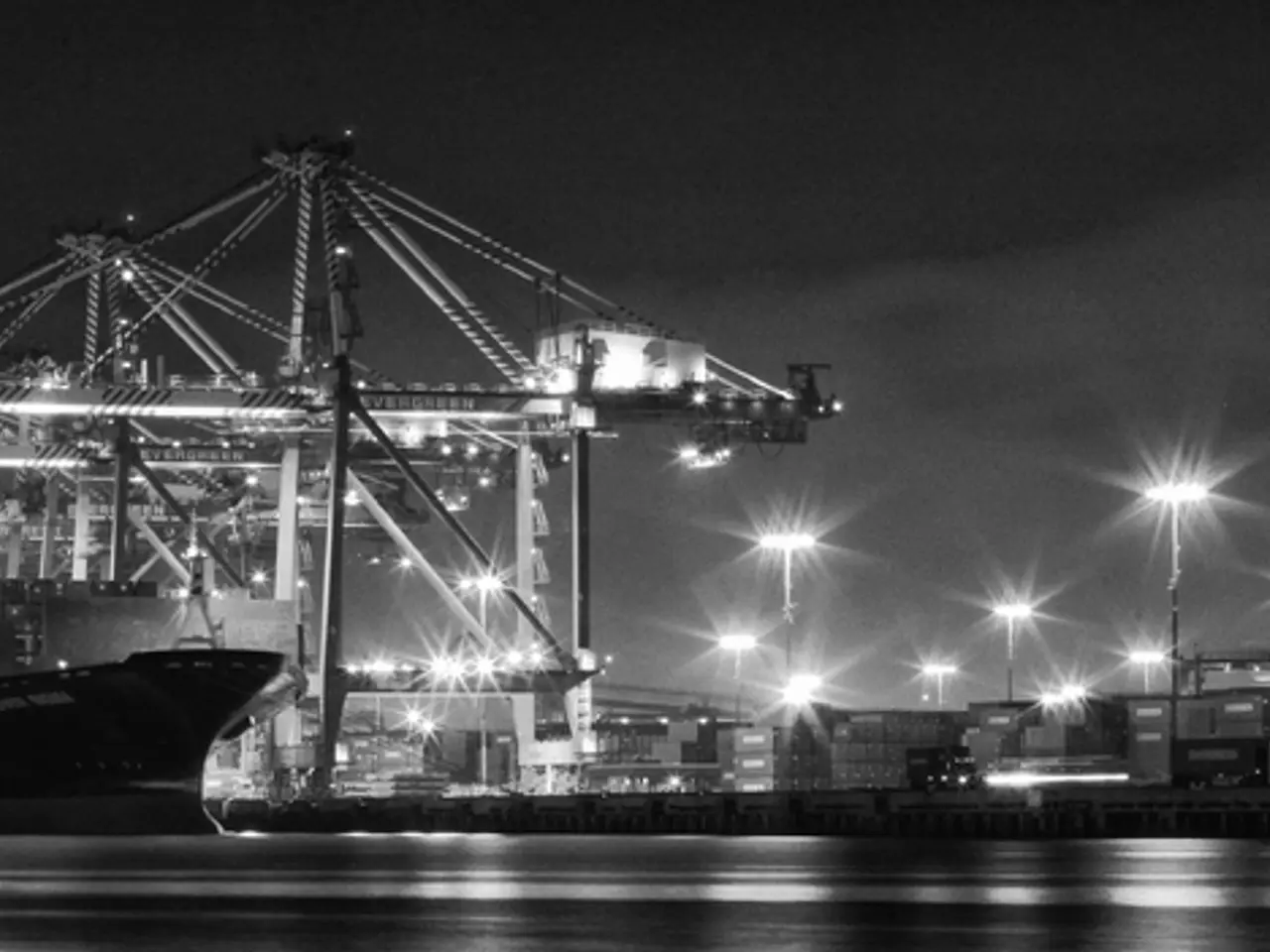
Enhanced tax incentives spark potential rivalry among Gulf coast shipping hubs
In an effort to bolster domestic manufacturing and reduce reliance on imported equipment, a new U.S. federal tax credit has been proposed – the Port Crane Tax Credit of 2025 [1][2][3]. Sponsored by Representatives Mike Ezell, Jen Kiggans, and Nicole Malliotakis, this legislation aims to amend the tax code to encourage the production of container cranes within the United States [3].
The initiative is seen as a counter to tariffs on Chinese-built cranes, which have raised concerns about economic viability and port productivity for U.S. operators. By financially supporting domestic crane manufacturing, the tax credit seeks to level the playing field for U.S. ports, particularly along the Gulf Coast, which compete heavily in cargo handling and container throughput [2][4].
Executive Director at the Port of Gulfport, Jon Nass, believes the legislation will bring new skilled jobs to Mississippi and reinforce its ability to compete globally [1]. Port Tampa Bay's president, Paul Anderson, stated that the tax credit addresses urgent national security concerns [5].
The increased demand and new growth opportunities for U.S. ports are due to manufacturing returning to U.S. shores [1]. However, the ports of Gulfport, Pascagoula, and Port Tampa Bay do not currently have domestic STS (ship-to-shore) cranes [6]. Port Tampa Bay, which installed Chinese-made cranes at its container terminal in 2016, supports the tax credit because it incentivizes U.S.-made port equipment [5].
The American Association of Port Authorities (AAPA) views the incentive as a first step towards incentivizing the reshoring of key container handling equipment [7]. Port Pascagoula Port Director Bo Ethridge stated that the tax credit is necessary to stay competitive and meet the demands of a modern, American-made supply chain [8].
The lack of cargo cranes at Port Pascagoula is an infrastructure gap that limits its ability to diversify commodities [9]. The bill's sponsors claim it will strengthen U.S. supply chain security and revitalize American manufacturing [3]. Last year, the Biden administration imposed a 25% tariff on Chinese cranes, and the Trump administration proposed raising it to 100% [10].
U.S. Rep. Jen Kiggans expressed concern about ports using cranes manufactured by Shanghai Zhenhua Heavy Industries, a Chinese state-owned company [11]. The tax credit is a vital step toward closing the infrastructure gap at Port Pascagoula [2]. The ports of Gulfport and Pascagoula in Mississippi, and Port Tampa see the tax credit as a way to help compete for business [12].
In summary, the Port Crane Tax Credit of 2025 promotes domestic crane production to boost U.S. port competitiveness relative to Chinese crane imports, especially affecting Gulf Coast ports by offsetting tariff-driven cost increases and supply chain vulnerabilities tied to foreign equipment [1][2][3][4]. The tax credit is expected to have a significant impact on U.S. ports, manufacturing, and national security.
Utilizing technology, the Port Crane Tax Credit of 2025 seeks to foster the development of ports with domestic STS (ship-to-shore) cranes, aiming to integrate American-made equipment in the supply chain. The initiative, led by Representatives Mike Ezell, Jen Kiggans, and Nicole Malliotakis, addresses the need for modern port infrastructure, particularly in sports cities along the Gulf Coast, to ensure smoother operations and sports transportation logistics.




